Some mining towns in the western United States went through their boom and bust cycle rather quickly but very few were as spectacular as Rhyolite, NV, in both the size of the boom or the tempo of the bust. In a scant 20 years the Rhyolite town site went from nothing more than rock and scrub brush through a booming metropolis to a ghost city, leaving some spectacular ruins behind.
What would quickly become the city of Rhyolite started with a population of two on Aug 9, 1904. Prospectors Shorty Harris and his partner Ed Cross discovered gold just south of what would become the Rhyolite town site. The ore they found assayed as extremely rich, word of the discovery spread like wildfire and in just days a tent and shanty town sprang to life.
Within weeks, the population of the area was in the hundreds and more than 2,000 mining claims covering more than 30 square miles had been filed by gold seekers and speculators alike. The population of the area swelled to approximately 1,500 in the six months following the discovery. As an indication that Rhyolite had arrived, a post office opened in 1905 in a small tent with 18-year old Anna Moore serving as postmaster. But it was after the February, 1906, sale of the biggest and most productive mine in the area, the Montgomery Shoshone, to industrialist Charles M. Schwab of Bethlehem Steel fame, that a fully-developed, fully functioning city seemed to fall from the sky, landing just north of the mine.
Schwab expanded mining operations dramatically, hiring more workers. He built a huge mill and expanded the tunnels and drifts of the mine. And, while doing all of this, he took on development of the town. All the modern utilities and municipal services were there including police and fire departments. Railroads linked Rhyolite to the outside world. The city had both telegraph and telephone service. Banks, businesses and churches flourished. Rhyolite had all of the normal things expected of a fully functioning city and there were some not-so-normal features including a public swimming pool, a public bath house, an opera house and ball fields. There was even a baseball team to play on the baseball field.
A rudimentary but functioning city government kept things on track, appropriating public money for the benefit of the city and its residents. All of this development, from the new mill to process huge amounts of ore to the three-story cut-stone bank building with it s Italian marble, was completed in just over two years. In the same two years, Rhyolite became the third largest community in Nevada with an estimated area population of more than 8,000. While that was a number bandied about freely, the city never claimed a population of more than 3,500. Things looked solid and sustainable.
But there were some impediments and, in retrospect, it seems that the underpinnings of the bust were happening concurrently with the boom. The 1906 San Francisco earthquake diverted some investment, holding continued development in check. The financial panic of 1907 tempered investment even more. And it seemed as though the high grade ore Harris and Cross originally found was running out at about the same time. Some hold these events to be Rhyolite s death knell.
Then the other shoe, the one that was bigger and heavier, fell soon after. In 1908, a group of minority investors in the Montgomery Shoshone mine believed it was overvalued and arranged for a British mining engineer to perform an independent analysis of its potential. The results weren t good, to say the least.
Investors bailed. The stock crashed. By the end of 1910 the mine was operating at a loss. It closed for good in 1911. Almost all of the miners who had been laid off left the area for other mines to work. Merchants closed their shops and moved on. All three banks closed in 1910. The post office closed in 1913. Electric service was turned off in 1916. The once burgeoning population dropped to under 1,000 and, by 1920, just 16 years after the initial discovery, was close to zero. In 1922 it was reported there was one resident left in Rhyolite. It was effectively a ghost city.
With no one to maintain the buildings and roads, by 1925 Rhyolite was already starting to crumble. With the growth of automobile tourism, it became part of the tourist attractions in and near California s Death Valley. Roadside vendors set up their tables to sell souvenirs to weekend tourists. A gas station was built out of a railroad caboose. In 1937, the train depot reopened as the Rhyolite Ghost Casino and Bar and, after it failed to attract enough patrons, became a small museum and souvenir shop that stayed in business well into the 1970s. In 1984, Belgian artist Albert Szukalski created his sculpture of The Last Supper which became part of the Goldwell Open Air Museum at the southern entrance of the ghost city.
But, perhaps most importantly, the city became a huge building supply. Much of the material used to build Rhyolite was salvaged for use in buildings in other communities. In some cases entire structures were moved to other communities. The union hall was moved to Beatty, NV, where it became the Town Hall. Two room cabins were moved and reassembled as multi-room homes. Many of the buildings in Rhyolite provided material for the Beatty Elementary School. In many ways and in many of the surrounding communities, Rhyolite continues to exist and serve the needs of the area.
The Photographs

The sculpture of the Last Supper at the Goldwell Open Air Museum at the entrance to Rhyolite.

The 1905 Tom Kelly Bottle House is made of more than 50,000 bottles that Kelly reportedly collected over six months. The three-room building has been used as a museum, part of a movie set and as a family residence. It was used in one way or another until 1969.

This eight-room school building was built to serve 250 students in first through eighth grades. It replaced the original one-room school which quickly proved far too small for Rhyolite s burgeoning population.

When the city was abandoned, the school building became a significant source of materials for construction in nearby towns. Some structures were moved from Rhyolite intact and used as public buildings, businesses or homes in those communities.
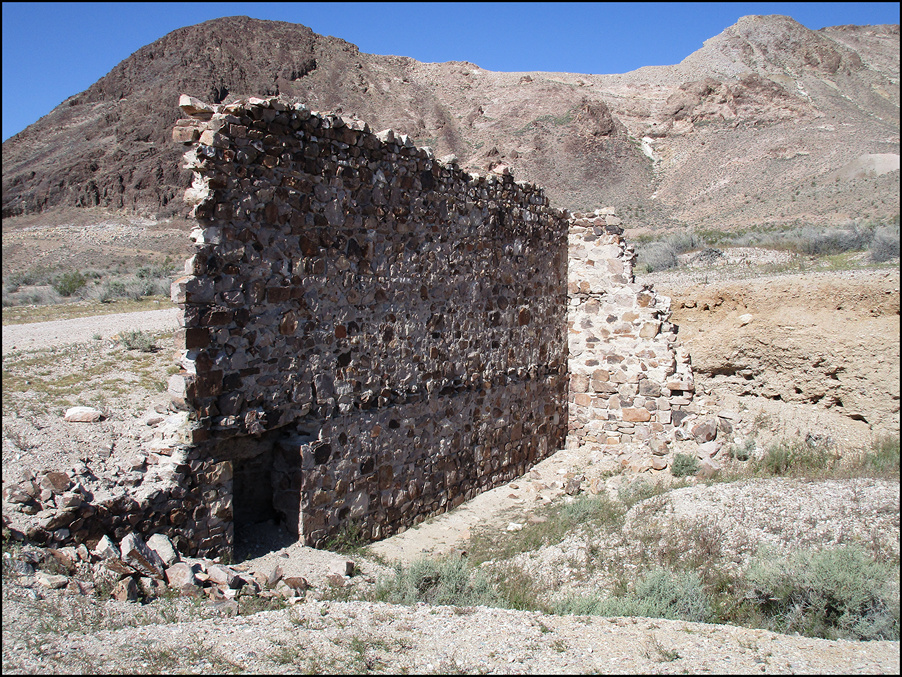
A freestanding wall from an unknown building.

Pillars in front of the ruins of the Overbury Building which housed a jewelry store and one of three banks that operated during Rhyolite s peak.

The vault of the Overbury Building still appears to be intact. The bank and jewelry store shared use of the vault.

Ruins of The Porter Brothers General Store from the back showing the remaining roof truss. Opening in 1906, Porter Brothers was one of the largest general stores in Rhyolite.

Ruins of The John S. Cook bank building, one of three banks in the city during its peak. It housed the city s stock exchange as well.

Entrance detail of the John S. Cook bank building. As the school building served as a building supply after the city was abandoned, the vault doors were removed many years ago and used in other banks in the region.

Front entrance to the Rhyolite train station which was built in 1906.

Front concourse of the Rhyolite train station.

Accumulated debris from various periods of the Rhyolite train station's use.

The freight loading platform of the Rhyolite train station. The platform was used as a dining patio when the station was converted to a museum with a small restaurant.

The rusted shell of an abandoned stove with the Rhyolite train station in the background.

With the advent of automobile tourism, this caboose became a gas station to serve the needs of tourists visiting the area.